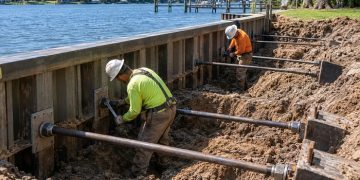







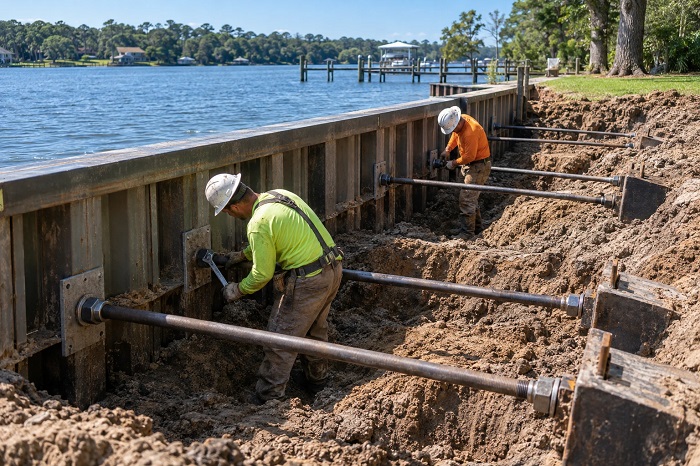
Tie-back anchors are not decorative hardware on a bulkhead. They are part of the system used to prevent the wall from moving under soil pressure. Shore Protect Team identifies tie-back anchors as a specific component of bulkhead construction and states that the required quantity depends on bulkhead height and soil type.
Owners planning a larger shoreline project can review the company’s waterfront construction capabilities work to understand where bulkheads sit among piling, retaining walls, piers, docks, and other marine structures. Anchoring decisions should be made in that full structural context, especially when a wall is retaining soil beside other waterfront improvements.
The anchor question starts behind the wall. A bulkhead separates water from retained soil, and the soil creates pressure that can push the wall toward the water. Tie-backs provide restraint against that movement. Their role is therefore different from drainage, which addresses groundwater pressure.
Soil type matters because it affects both the foundation and the forces acting on the wall. The bulkhead page notes that soil characteristics determine pile driving depth and the need for additional reinforcement. It also states that soft soils require deeper piles.
Wall height matters as well. The page directly links the number of tie-back anchors to bulkhead height and soil type. This means the anchor layout should be selected for the actual structure instead of copied from a nearby property with different dimensions or ground conditions.
For repair and new construction alike, the bulkhead anchor and repair services confirms that tie-back anchors, drainage, pile driving, and material selection are part of the same planning process. An anchor should not be evaluated as an isolated piece of hardware.
What tie-backs are intended to resist
The primary purpose described on the service page is to prevent displacement under soil pressure. That focus helps owners distinguish anchoring problems from water-side exposure. Strong waves can affect the wall from the front, while retained soil acts from behind it.
Both conditions can exist at one site, but they are not solved by the same component. A wall on an open shoreline may need a material and foundation appropriate for wave action while also requiring anchors sized for the retained soil.
- Soil pressure – The force that tie-back anchors are intended to resist.
- Bulkhead height – One of the factors that influences the quantity of anchors required.
- Soil type – Affects both anchor planning and the broader foundation design.
- Pile depth – May need to increase in soft soils according to the bulkhead service information.
- Drainage – Handles groundwater pressure and should be planned separately from anchoring.
Anchors and piles solve different parts of the problem
Piles support the bulkhead and transfer forces into the ground. Tie-back anchors restrain the wall against movement caused by retained soil. The page’s description of bulkhead planning makes clear that both may be part of the same installation, but their jobs are not interchangeable.
This matters when comparing bids. A proposal that increases pile depth but omits anchor information is not automatically equivalent to a proposal that includes tie-backs. The owner should ask how each component is intended to address the site conditions.
Anchor replacement can be part of repair
Shore Protect Team lists anchor replacement among its bulkhead repair services. That means an aging wall does not always have to be discussed only in terms of replacing visible panels or boards. The condition of the anchoring system can form its own part of a repair scope.
A repair assessment should therefore look beyond surface damage. If the wall has shifted or if anchor components are no longer performing as intended, the scope may need to include structural restraint as well as restoration of damaged sections.
- Measure the existing wall and identify the retained height.
- Review soil conditions behind and below the bulkhead.
- Inspect the existing anchor system where it can be evaluated.
- Separate groundwater issues from soil-pressure restraint.
- Confirm whether repair requires anchor replacement, wall restoration, or a broader structural scope.
- Match any new anchoring work to the foundation and wall material selected for the project.
Questions worth asking before construction
A useful discussion with the contractor should explain why tie-backs are required, what site factors determine their quantity, and how they connect to the rest of the bulkhead system. It should also clarify how drainage and piles are being handled so that one component is not expected to perform another component’s job.
The most reliable anchor plan is therefore site-specific. Soil type, wall height, foundation conditions, and the existing structure all matter. Treating the anchor system as part of the overall bulkhead design produces a clearer scope than simply adding a generic number of tie-backs to every shoreline wall.
What changes when an existing wall already has anchors
An existing bulkhead can contain anchors that were installed with the original wall, replaced during a previous repair, or left in service while other sections were restored. A repair review should identify the condition and role of that existing restraint instead of automatically adding new anchors or assuming the old system remains adequate.
Anchor work can also affect access behind the wall. Unlike surface repair on the water side, tie-back work may require access to retained soil or connection points away from the visible face. The property layout can therefore influence how practical a localized anchor repair is and how much disturbance is required to reach the system.
For owners comparing repair with new construction, this distinction is important. New construction allows the anchor plan to be developed with the wall from the beginning. Repair has to work with whatever components remain in place. The scope should state which anchors are retained, replaced, or added and how that decision relates to the existing piles, wall height, and soil conditions.