



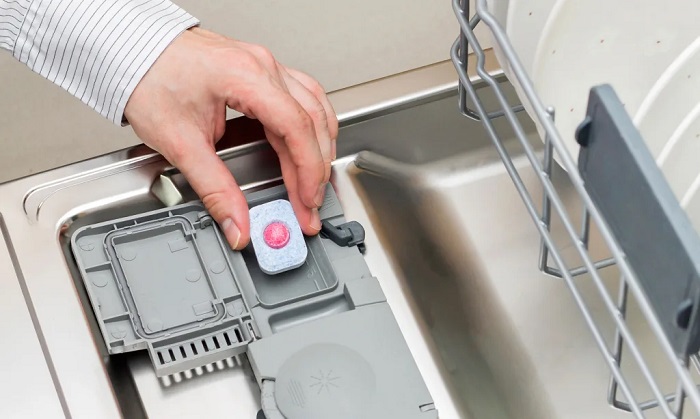
If the tablet or powder remains in the dispenser after a wash cycle and the dishes come out caked, the problem is most often due to the dispenser not opening in time or not releasing the detergent completely.
The problem can be as simple as improper loading of dishes, a wet tablet, or a technical issue such as a stuck lid, worn latch, or a control malfunction. Below is a practical diagnostic and possible solutions, fix dishwasher.
Typical symptoms and what they mean
- An intact tablet in the dispenser – the lid did not open, or it opened but the tablet was blocked by dishes/a weak water flow.
- The detergent powder has caked together – high humidity in the compartment, a wet tray, improper storage of the detergent.
- The dispenser lid is slightly open, but the detergent has not been rinsed out – a blockage, poor circulation, an incorrect program, overloaded baskets.
- The dispenser does not latch – the latch is worn, the lid is deformed, grease/scale is stuck in the mechanism.
Quick fixes that can be resolved without disassembling
- Dishes are blocking the lid. Check that a large plate, baking tray, or frying pan handle isn’t resting against the dispenser lid. There should be some space between the lid and the items.
- Inappropriate placement of dishes. Tall items in the lower basket can sometimes block not only the dispenser but also the spray arms, preventing proper rinsing.
- Damp dispenser. Wipe the tray dry before adding powder or tablets. Moisture can cause sticking and clumping.
- Tablet problems. Storage in damp conditions or a damaged shell will impair dissolution. Try a new batch or temporarily switch to powder to test.
- Incorrect program. Short cycles at low temperatures may prevent the tablet from dissolving. For the test, select the standard/intensive program.
How to tell if the detergent/tablet drawer isn’t opening during the cycle
If dishes remain greasy, with a film and odor after washing, and the quality has noticeably deteriorated without changing the program or load, one common cause is that the drawer isn’t opening, and the detergent isn’t reaching the chamber at the right time.
This can be verified by indirect signs and by the condition of the dispenser after the program ends: most often, the problem is immediately apparent by inspecting the compartment and comparing the wash result with a normal one.
Signs that the dispenser hasn’t opened
- Detergent remains in the drawer: the tablet is whole or has become soggy, or the powder is caked or in a lump.
- The compartment lid is closed after the program ends: normally, it should be open and remain open. position.
- There are visible streaks or traces of undissolved detergent on the inside of the door around the dispenser.
- The dishes are washed “as if with water”: a greasy film, cloudy glasses, food residue on plates, especially on short/eco cycles.
- At the end of the cycle, there is no characteristic detergent odor in the chamber (it is often noticeable during normal operation).
- There is no foam or traces of detergent on the bottom of the machine (when using powder, signs of its action are usually visible, although there may not be strong foam).
- After the program is complete, open the door and check the hopper: the lid should be open and there should be no detergent.
- Inspect the tablet/powder: if the detergent remains, it did not reach the wash chamber in time or was not washed away by the water.
- Evaluate the result on “difficult” dishes (frying pan, saucepan, plastic): the deterioration is usually most noticeable when the drawer is not open.
Bottom line: the main indicator is detergent residue in the compartment and/or a closed dispenser lid after washing, accompanied by a decrease in cleaning quality. If these signs are repeated over several consecutive cycles, it can be assumed that the drawer is not opening or is opening incorrectly.